
Everything's New In Seattle
Nostalgia, spite mounds, and the relentlessness of change

I grew up on Vashon Island, a charming little tangle of land left above sea level when the scouring Cordillerian Ice Sheet receded to make way for today’s vegetarian bakeries, quirky Baby Boomers, roadside farm stands, and beaches plucked from the twitching dreams of Labrador Retrievers.
As a teenager, I was desperate to leave. As soon as I was old enough to take the ferry to Seattle with my friends I did so with regularity. My memories of the city are a fond, hazy mosaic of interminable rides on the 54 bus, chanting “Jesus Christ Made Seattle Under Pressure,” purchasing crop tops and Beat Happening tapes in the basement of the Capitol Hill Red Light, eating cheap platters of peanut sauce-draped broccoli and tofu called “Swimming Rama,” attending grimy house parties in West Seattle, and stressing about catching the last boat home.
Then I moved to Portland in 2004 and never really looked back, which means my mental image of Seattle froze somewhere around the dot com bubble. I knew Seattle had been profoundly changed by tech and its billowing clouds of wealth, but somehow I had mostly avoided seeing it. Call it willful ignorance. But a couple of weeks ago I found myself solo in downtown Seattle for 36 hours, my only obligations two five-hour stints as a judge for a wine competition. I was committed to using the opportunity to get up to speed, and I had three things on my progress-surveying agenda: The new Waterfront Park, South Lake Union, and the light rail.
I headed for the waterfront first, walking through the Pike Place Market early one morning to the soundtrack of bleeping of trucks and chattering delivery drivers. No shade to the fish guys, but to me the heart of the Market is the weird layered warren beneath them filled with bead stores and import shops and haunted-seeming stairwells that smell like cigarettes and pee. Every now and then in the old warren you’d peek through a window and see a little slice of the Alaskan Way Viaduct, the raised highway that hemmed in the west side of the market and once separated Seattle from the waterfront. The 2001 Nisqually earthquake sent it off-kilter, and it was finally replaced with an underground tunnel. Its last vestiges were torn down in 2019. Now unencumbered, the city could finally meet Elliott Bay’s twinkling eye contact, opening a new $850 million park to mark the occasion in September 2025.
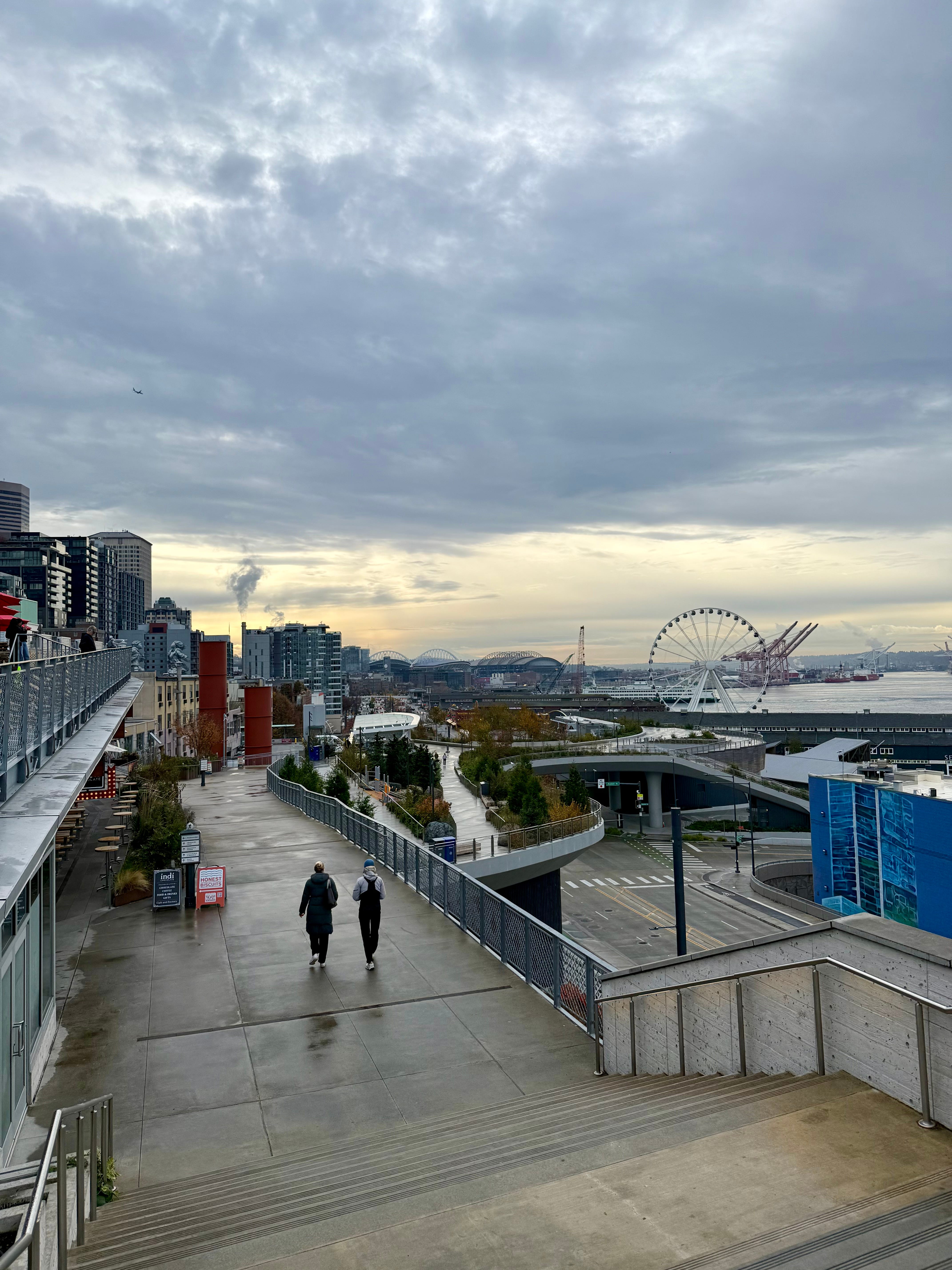
It spills down from the Market in a series of stairs and terraces and sweeping walkways, all with unobstructed views of the Sound and, presumably on a clear day, the Olympics. That early gray morning it felt like an architect’s rendering come to life. Careful curves and thoughtfully sited landscaping was populated by dispersed, well-dressed people of various ages and ethnicities walking small dogs, commuting by bicycle, carrying luggage, jogging, walking alone or in twos, putting something in the recycling container. I walked all the way to the bottom and out onto the pier to look back at the city. Seattle is so much grander, so much nicer than Portland, glittering with reflected light even on the bleakest of November days.
Like a moth, I ascended the stairs towards the gleaming cityscape and headed up Pine, passing the former location of the grubbiest of teriyaki joints I once frequented (RIP Osaka Teriyaki and your $3.95 chicken combo plate), then turned left on 7th and headed towards South Lake Union. I remember this neighborhood as essentially downtown’s back room, a hodgepodge of parking lots, car washes, Guitar Center, and warehouse-based businesses that all did something with boats. Today it is the epicenter of New Seattle Tech, a futuristic sub-city of gleaming glass and ghost kitchens. All I recognized was the rotating Pink Elephant Car Wash fluorescent sign repurposed into kitchy street decor. In the ground floor of an ultra-modern building packed with algorithmic worker bees was, in what had to be actually quite a clever joke, a Sub Pop store.
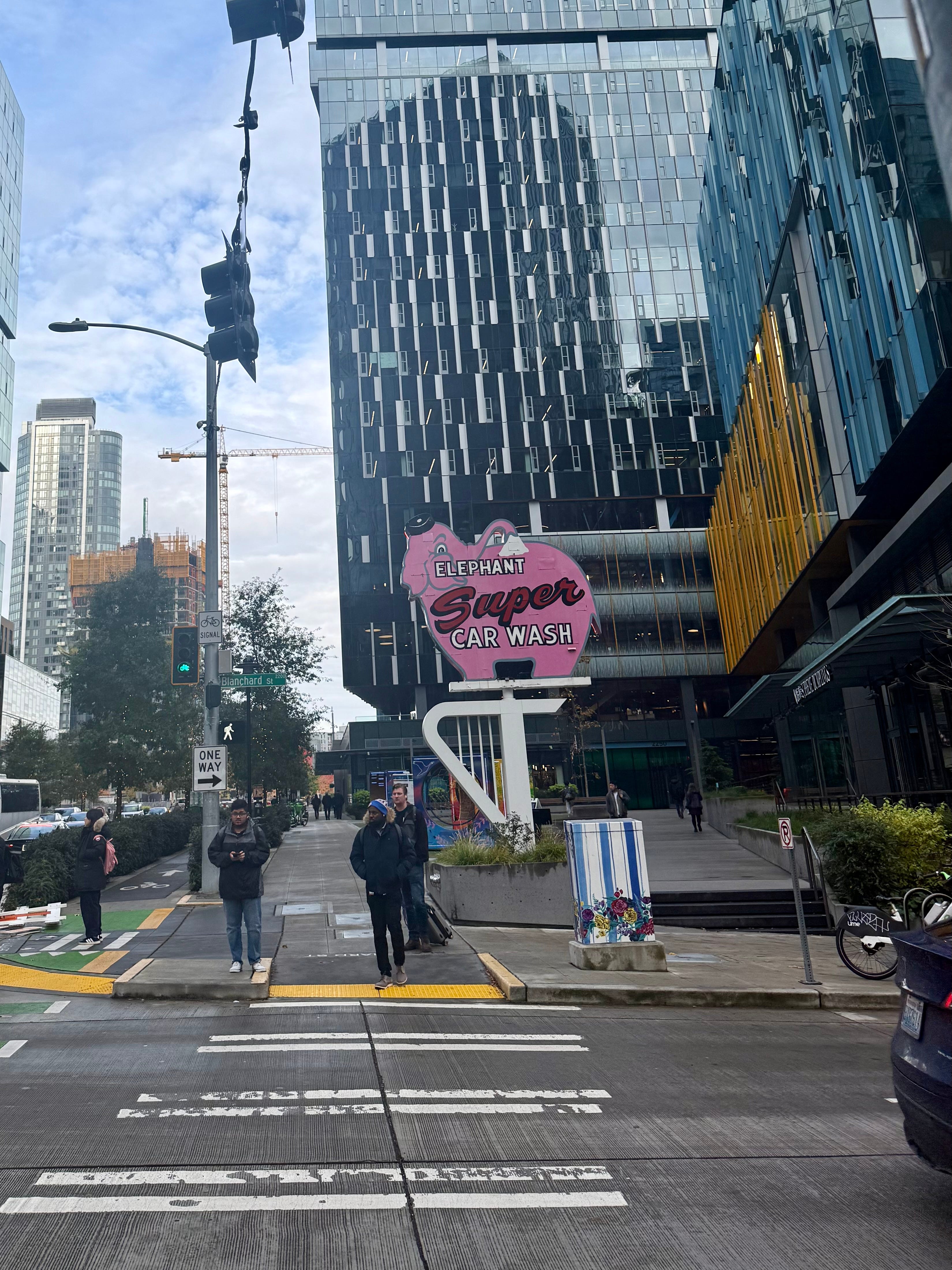
I go to San Francisco fairly regularly and am thus up to speed on its various futuristic elements: Self-driving Waymos, dystopian income inequality, bewildering billboards that foreshadow the imminence of some new technological horror we will all be forced to learn how to use or at least develop an opinion about. But walking through that part of Seattle was like seeing an old friend, aging poorly, for the first time in decades. The changes were so dramatic and so startlingly obvious they rebounded, becoming a mirror to my own unstoppable march towards obsolescence. I’m rubber and you’re glue, what bounces off me sticks to you. I left SLU feeling like a living fossil.
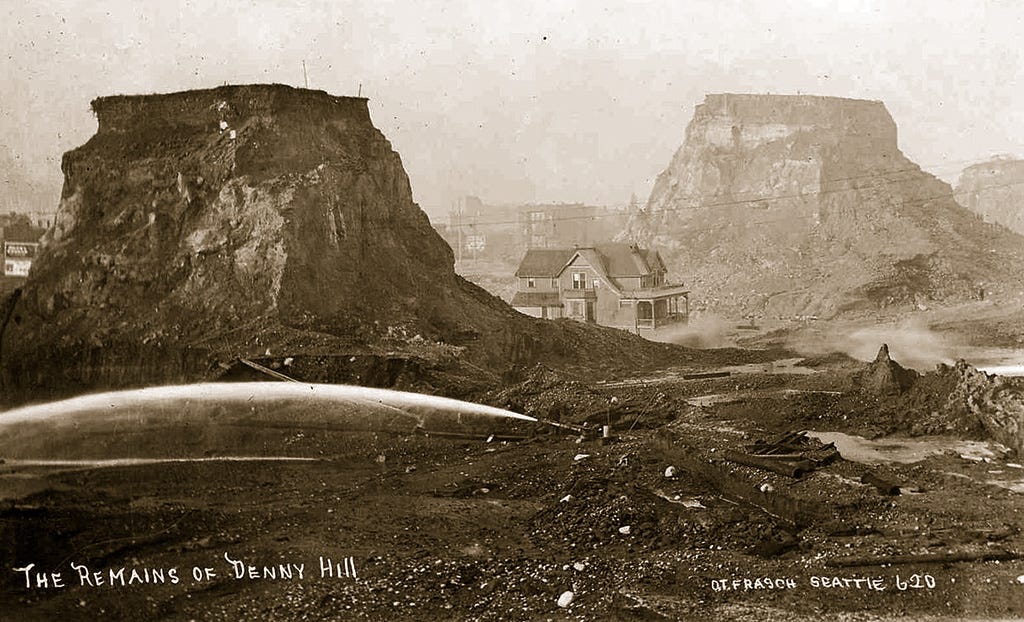
I try to find solace in the fact that this sort of thing is par for the course for Seattle, which has never gone long without a massive physical transformation. In the Denny Triangle, contour lines on the crosswalks indicate the former slope of the landscape before it was leveled in the “Denny Regrade,” a public works project that erased an entire geographic feature. Between 1897 and 1930, a huge section of what is now downtown Seattle, 65 blocks or so, was lowered by 100 feet to ease transit and commerce. Much of it was literally washed into Elliott Bay, reshaping not just the buildings and businesses but the actual landscape itself right down to the sea floor. Holdouts not yet willing to scrape their parcels to the new grade left “spite mounds,” tiny weird buttes in a scoured landscape, monuments to their opposition to progress. Like Bartleby, they lost in the end, and eventually the whole section of what is now Belltown and lower Queen Anne was lowered, smoothed, and gridded such that commerce could flourish.
I’m not usually a change resister by default. I lack the stamina for futility. Many of the new things about Seattle are improvements. The light rail is easy, fast, convenient, so much better than slogging through traffic. Strolling over a seismically optimized skybridge filled with public art to the sparkling Sound is objectively much nicer than wending through a maze of sketchy urine-scented stairwells and huge concrete pillars to get to the waterfront. The Viaduct was terrifying to drive on even before it was going to fall over. Someday I will go on a tour of The Spheres, the twin glass domes in South Lake Union housing what appears to be a collection of enormous houseplants, and enjoy it.
Adapting to change seems to be a core proposition of the human condition. Still, I don’t think you’re required to approve. Jeff Bezos may not have topographically reshaped South Lake Union with the same vigor as those 1920s earth movers, but the social changes carried out by big tech over the last two decades are even more profound because they are so much harder to opt out of, dissolved inescapably through modern life like salt into water, vapor into air.
On my way to the light rail station, late and lugging my suitcase, I dashed into a convenience store to get a snack for the flight home. To enter, I had to tap a credit card and was pre-charged $25. To exit, there was no cashier. “You’ve already paid,” the attendant explained to me. “How do you know who took what?” I asked. He gestured up towards the ceiling. “Thousands of cameras,” he says. “And sensors on every shelf.” If that doesn’t inspire you to build a spite mound, I don’t know what will.
Other Stuff
The only place I ate in Seattle worth mentioning is Le Pichet, a wormhole to Paris as cozy and chic as a cashmere sweater. A ballet dancer of a hostess, perfect steak frites, a glass of cab franc, a good book, and a chatty neighboring table on their way to see Patti Smith play the entirety of Horses made this the platonic ideal of a solo dining destination for moi.
I have a new Travel Oregon story out about Oregon’s ocean beaches. Is it truly “the ultimate guide?” Perhaps not, but only because there are too many greats to list in 800 words. Here’s one that didn’t make it into the guide: Little Beach in Gearhart, which is a good place to crab snare and has that rarest of resources on Oregon’s riptide-torn coastline, a great swimming beach.
It’s the holidays, which means you’re probably cooking more than usual, which means you should get your knives sharpened. If you live in Portland you should do so at Sharpening4U. I love everything about this place. Its clunky T9 text message name. Its surly proprietor. That it is located on a part of Sandy Boulevard that is pretty much impossible to get to. The defiantly unmerchandised interior, piled with reel mowers and random knives and a rack of extremely dusty handmade aprons that nobody ever seems to purchase. The system of index cards used to keep track of your order. The strident signage everywhere you look. The only begrudging acceptance of credit cards. The 1995 website. It is a tiny kingdom where nothing is new and a chaotic dictator invariably returns your knives murderously sharp. If it existed in 1920s Seattle, it would certainly sit atop a spite mound.
It’s nice to hear that my two favorite Seattle institutions: the weird underground hippie shops of PPM, and Le Pichet, are still holding their own against the rising tide of hyper-branded mediocrity and uninspired glass-and-steel cybertecture that is coming to define contemporary Seattle.
Great piece Martha; I learned stuff.