Blocked Signals
Lighthouse fantasies, J Pod, warning signs, and wanting-but-not-getting on Vashon Island

About this time last year, wallowing in midwinter malaise, I made several impulsive travel arrangements for the year to come. One of those was reserving the lighthouse keepers’ quarters at Point Robinson Park on Vashon Island for the week of Christmas.
Did I know for sure I would be spending Christmas at home with my family? Was I certain Andy would want to go along for five whole days? Did I have a plan for this time beyond the vague urge to have something to look forward to? The answer to all of it was no, but I made the reservation anyway and told myself I’d just cancel if anything came up, which it probably would.
Point Robinson sits at the island’s easternmost point, a kicked-out knee of land jutting into Poverty Bay just across the water from Federal Way. It has two beaches: a rocky one facing southeast and a sandier, quieter one facing northeast protected by a hidden sand bar that only emerges during the lowest tides (and is the reason for the light house in the first place).
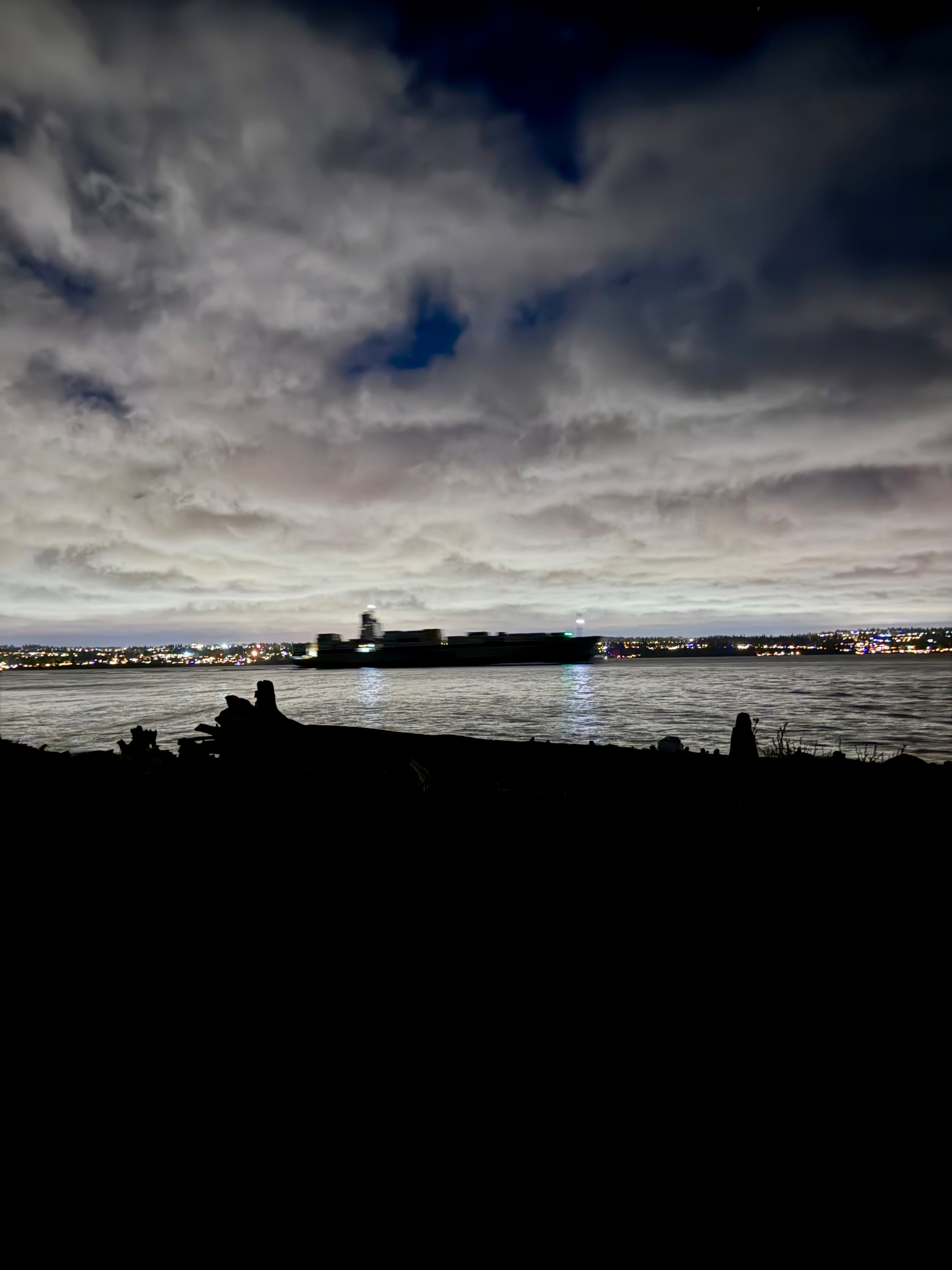
There’s also a little network of trails in the woods on the hill, a few kayak-in camping spots, and tons of driftwood and thus driftwood forts. On a clear day, it’s a great place to see Mt. Rainier and hunting osprey. At night, you can watch the planes stacked six deep waiting to land at Sea-Tac, long-hauls from Amsterdam and Singapore and Seoul depositing their tidy rows of passengers in a morse code of little dollops.
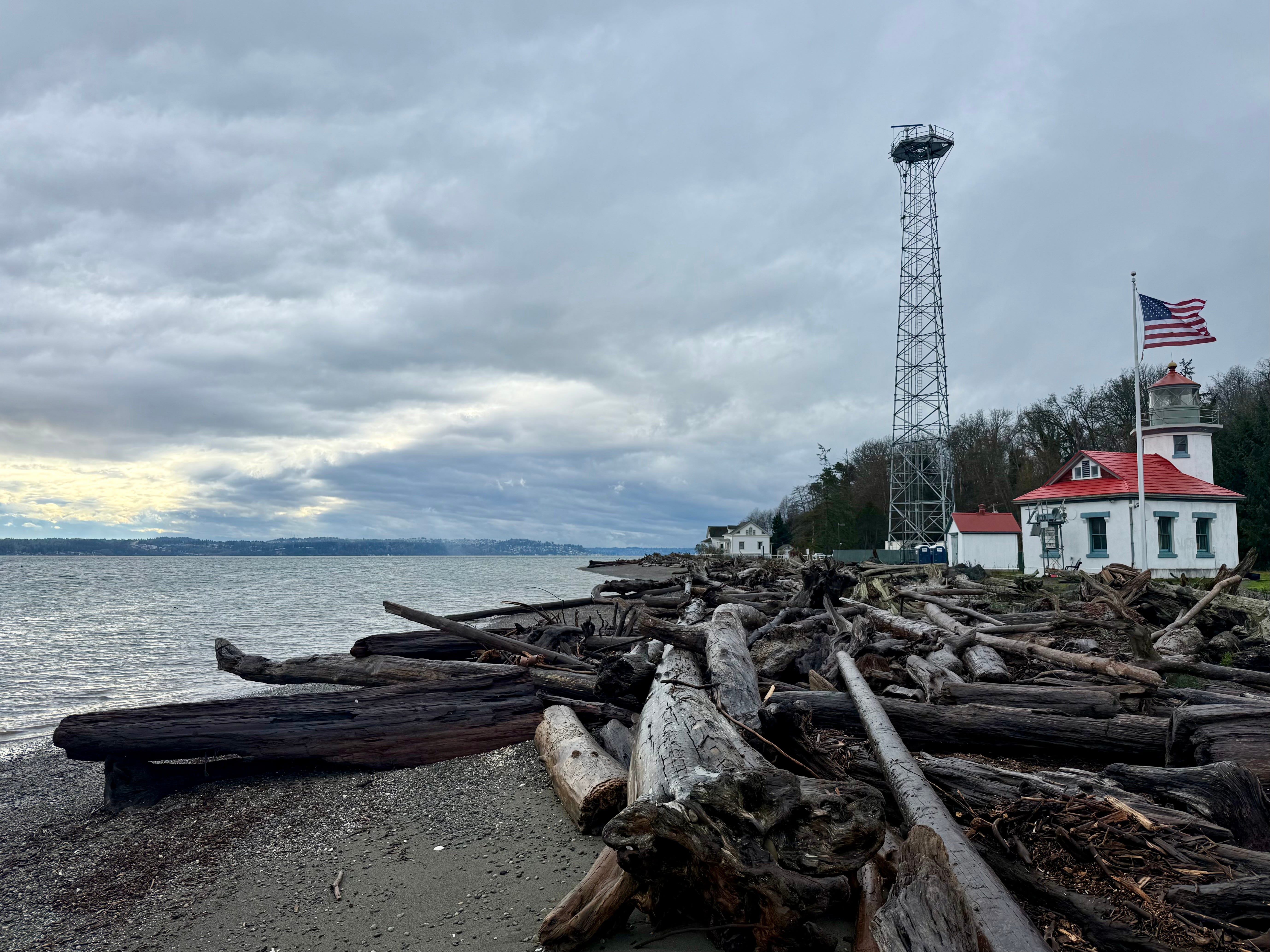
Back when the long-hauls were arriving exclusively by sea, the area around Point Robinson was a problem. Besides that long sandy shoal, there was also the “fog net” of persistent mist shrouding the point. It was all very dangerous for sailors. Clearly what was needed was a signal. And so a fog horn was built, sounding its first steam whistle blast in 1885.
Soon after that came another tower to hold a light, followed by several additional buildings to make life more comfortable for the now-required lighthouse keeper, including two sets of living quarters, a barn, and a chicken coop. Nearly 150 years later the lighthouse, now fully automated, remains in operation, while the other residences have been refurbished by a group of volunteers into rentable guest quarters.
To my delight, 2025 passed and I never did get around to cancelling those reservations. We arrived on December 23rd a little after six in the evening. It was already pitch dark and had been for hours, but we could see the quarters’ whitewashed exterior walls glowing ghostly in the light of the beacon, which still flashes on a 12-second cycle.
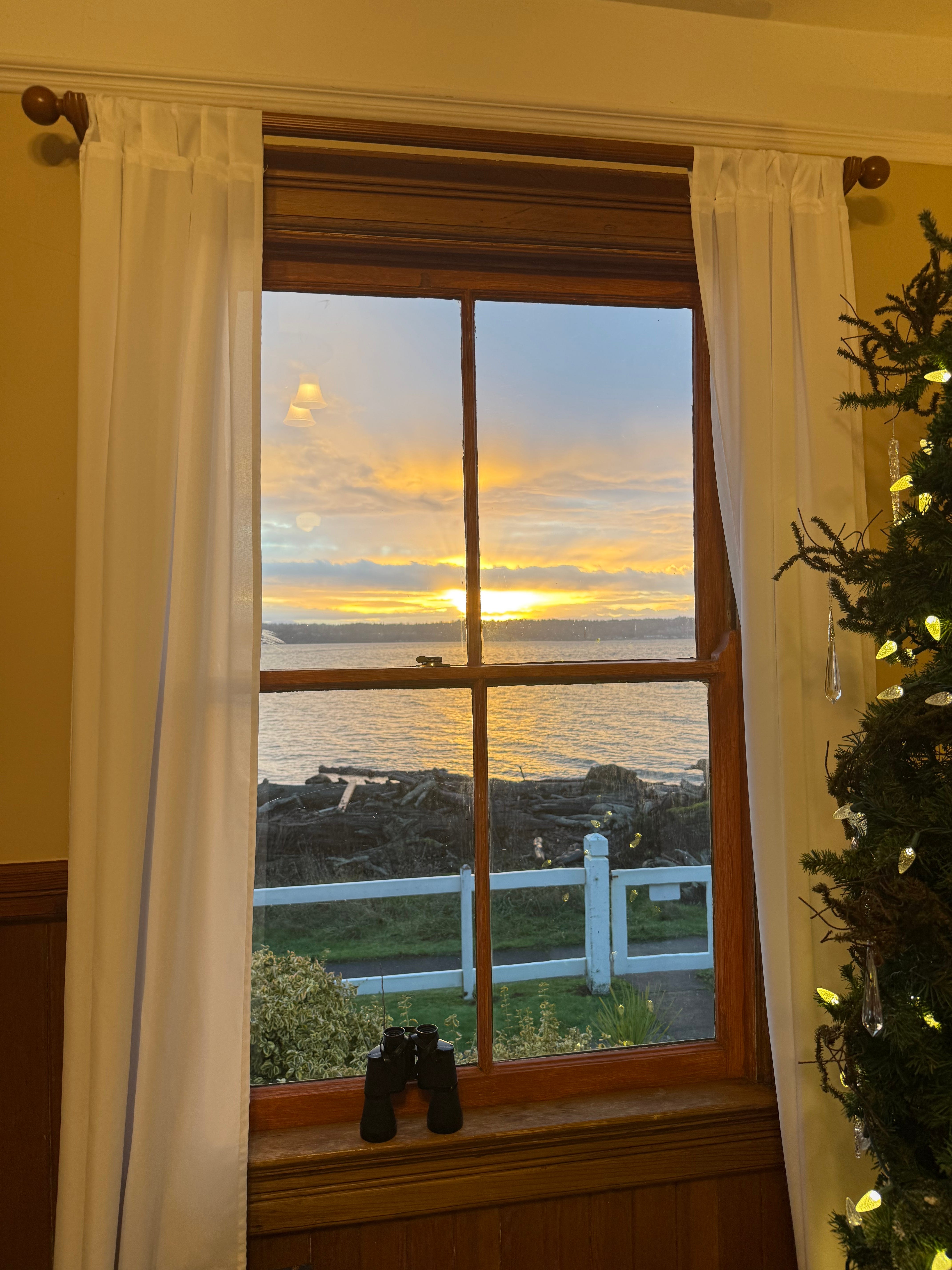
Inside, historically minded volunteers have ensured the quarters retain a flavor of the time when they were built. There are embroidered bedspreads, a vintage washbasin in the bedroom, lace curtains, and sepia photographs of former residents on the living room wall. It is an ideal place to fantasize about history, and thus an ideal place to stay while visiting an old home town.
Soon we met the caretaker at the gate. It was so dark we could barely make one another out, but after the standard islander chit-chat to suss out mutual acquaintances he moved on to more important matters. “I’ve seen orcas the last three days,” the short, friendly, invisible presence whispered into the night. “J Pod. Keep an eye out.”
There are three resident orca pods — large extended families of whales assembled around a matriarchal core — in Puget Sound: J Pod, K Pod, and L Pod. Critically endangered, they now comprise just 74 whales, each of whom has a name, distinctive markings, and a fully mapped family tree.
These residents spend their lives in the Salish Sea, and they eat almost exclusively salmon, ideally Chinook. Transient orcas, on the other hand, travel up and down the coast in smaller groups and eschew fish in favor of other mammals, like seals and sea lions. They are so distinct from residents that the two are now considered a separate species.
While transient orcas seem to be doing OK, Puget Sound’s resident orcas are the unfortunate protagonists of a great tragedy. Their primary food source is disappearing while their bodies accumulate immense concentrations of toxic chemicals washed into the sea from the cities ringing the Sound. Constant vessel noise makes it hard for them to communicate and hunt. Most of their calves die because their mothers offload so many toxins into their bodies while struggling to feed them enough to sustain life. In 2018, one whale in J Pod carried her dead calf for 17 days before its body decayed too much for her to continue. Seeing them always feels like crossing paths with a band of apocalypse survivors, the last remnants of a once-great civilization keeping the faith on radioactive scraps. Their presence feels like another sort of signal, a flashing red warning sign trying and failing to grasp our attention.
After that conversation with the caretaker I urgently wanted to see J Pod, and the intensity of this desire made me feel sure that it would come true. Wasn’t it Christmas, the season of wishes granted? So the next morning, while I waited for my English muffin to toast, I scanned the horizon. A choppy sea made for tough whale spotting conditions, but I would still be able to see their foggy puffs of salmony breath.
Might this be the fourth day they pass the point, known for its good winter fishing? I looked and looked, yet I saw no whales, and soon holiday preparations beckoned. Off I went to my mother’s to wrap presents, chat with my cousin, eat lasagna, stuff stockings, and pet the dogs as part of my own little matrilineal pod.
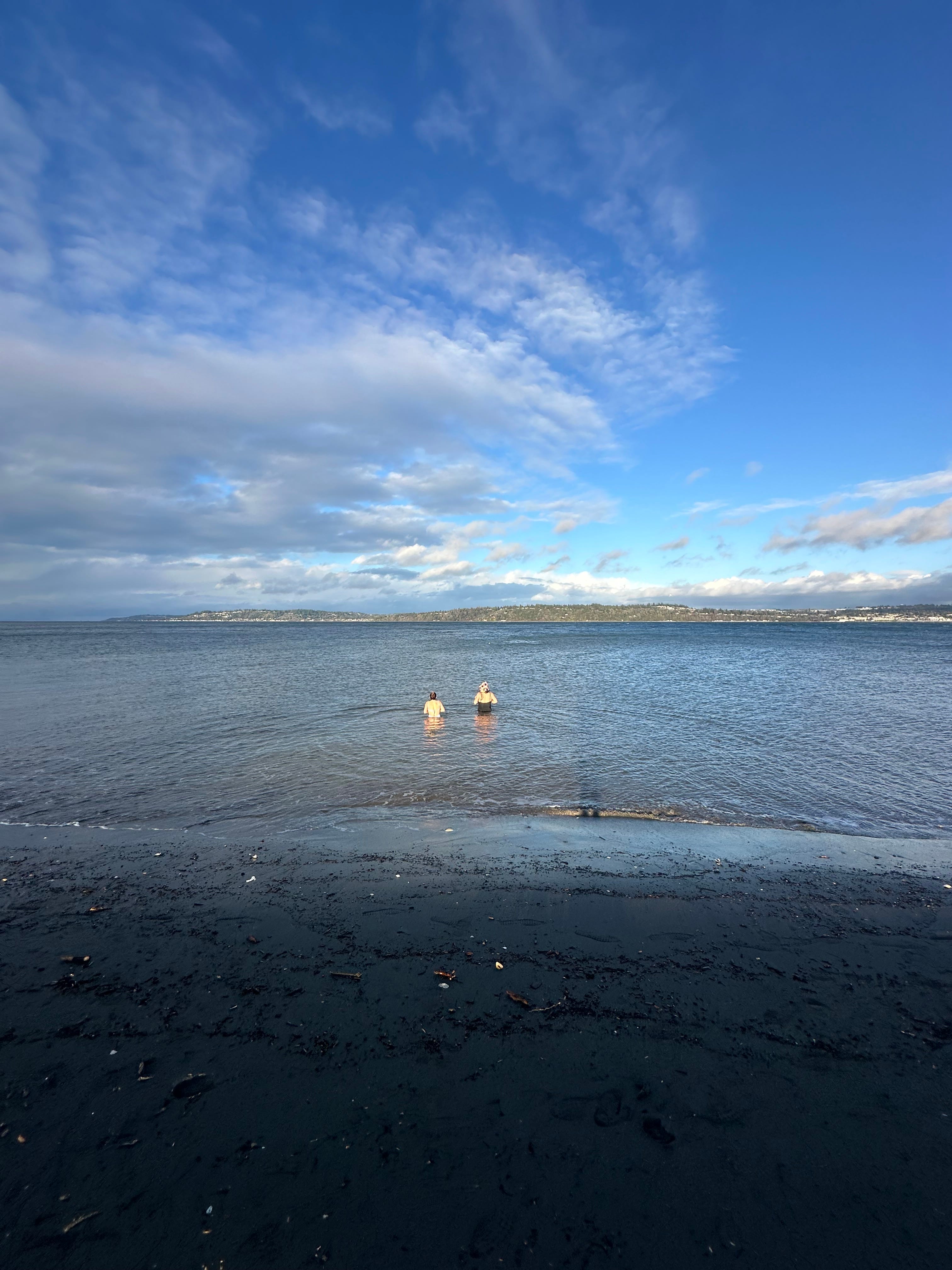
The next morning, Christmas morning, I felt even more sure that J Pod would appear. Didn’t it sound right to see whales on Christmas morning — a gift from the universe? Yet once again, I saw nothing. Later that day my cousin and I went for a swim. December had been unusually rainy and the Sound was filled with murk and debris — not just the usual melange of bits of seaweed and little moon jellies, but whole trees and broken pieces of decking swirling through chocolatey water, no doubt freshly laced with another round of fat-soluble chemicals that would eventually find their way into the bodies of moon snails, candlefish, salmon, seals, whales, and my cousin and me.
We found a clear-ish spot to dunk, and it was so invigorating we did it again the next day off the sandy side of Point Robinson, little zaps of clarity that cut through too many cookies and glasses of Bordeaux the night before. Both times, of course, I scanned the horizon, feeling that being immersed in the water myself would, through a mysterious property of kinship, summon J Pod. Weren’t their dark, bouncy sides being brushed by the same cold salt, tickled by the same tangles of uprooted alders? And both times, the horizon was empty.
My last morning, I took my coffee out into one of the driftwood shelters. A carpet of slimy eel grass pulsed with sand fleas. I looked and listened one last time, but didn’t see them. J Pod must have moved on, following the last of the chum or the squid to some other corner of the Sound, not receptive to my wanting after all.
I saw other things, though. I saw seals, their shiny round heads bobbing gently in the whitecaps. I saw but mostly heard a pair of eagles delicately kittering to one another on their morning rounds. I saw cormorants shooting across the surface of the water like oily black arrows. I saw planes circling. A huge ship thrummed past, loaded with cars or air conditioners or cashmere sweaters or industrial gears or instant noodles. I saw no other human beings, but across the water I could see a traffic light flash from green to red, green to red, green to red.